
Dimacs
The proprietary platform with which we manage over 11,000 instruments: automatic scheduling, traceability and certificates always available.
Case study · Pharmaceutical
From calibration managed on Excel and paper to a metrology process under control: automatic scheduling, traceability of every operation, certificates always available and formal handling of Out of Tolerance events, compliant with ALCOA+ principles and Annex 11.
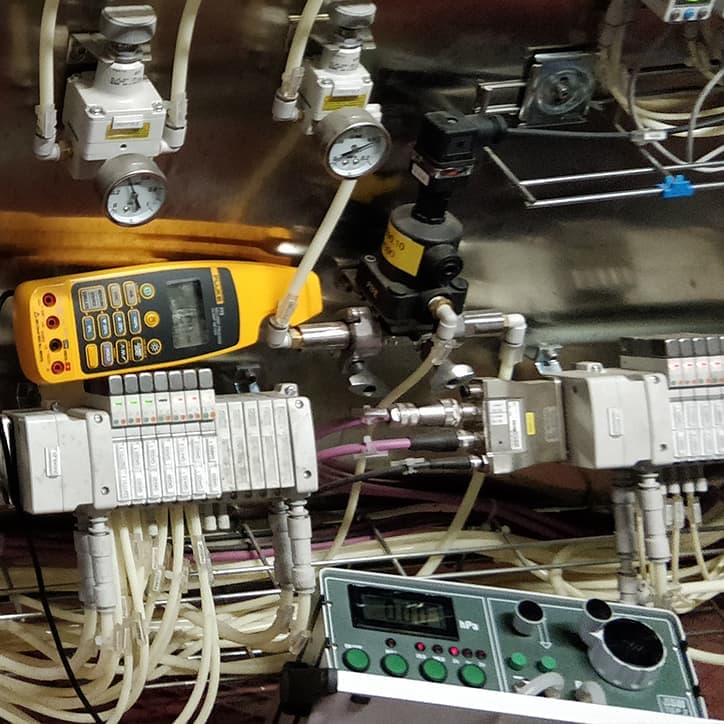
A major pharmaceutical site in Lazio managed the calibration of an extensive instrument fleet with Excel sheets and paper records. At this scale the approach showed the known limits of manual management: uncontrolled versions, risk of missed due dates and the absence of a reliable audit trail. In a regulated environment, calibration records are GxP data in every respect and must comply with data integrity principles (ALCOA+): attributability, contemporaneousness, completeness and immutability. Calibration needed to be transformed from a static archive into a controlled process, compliant with Annex 11 and auditable at any time.
The starting point was a complete inventory of critical instrumentation, with a unique identifier, metrological record (range, required accuracy, conditions of use, GMP function) and documented critical/non-critical classification. Without a complete inventory there is no metrology system.
With Dimacs, Eurosystem's proprietary platform, calibration planning is managed with automatic scheduling and preventive alerts: no critical instrument operates past its due date. Certificates and history remain always available and consultable, rather than scattered across files and folders.
Out of Tolerance events are treated as potential retroactive deviations, not as simple recalibrations: event recording, deviation analysis, assessment of impact on data generated since the last in-tolerance calibration, interval review and traced case closure.
Dimacs is designed around data integrity principles (ALCOA+) and Annex 11 requirements for computerized systems in GMP environments: non-disableable audit trail, recording of As Found and As Left, traceability of changes including master data. Development and support are in-house at Eurosystem, so the platform evolves with the real needs of the sites.
The proprietary platform with which we manage over 11,000 instruments: automatic scheduling, traceability and certificates always available.
Calibration and management of critical instrumentation with full traceability and Out of Tolerance handling.
How to manage calibration in GMP: critical instruments, traceability, intervals, Out of Tolerance, audit trail and data integrity.
A critical instrument out of tolerance at the periodic calibration is not just an instrument problem: it is a potential retroactive deviation. How to conduct the impact assessment according to GMP.
Criteria for setting and reviewing calibration intervals: criticality, drift, use conditions, history, OOT events and documented justification.
On a few dozen instruments and low inspection-risk sites an Excel sheet can work, but only with a level of formal validation under Annex 11 that erodes its advantages. On fleets of hundreds or thousands of units, manual error grows, the audit trail is missing and management becomes structurally fragile: a dedicated, GxP-qualified system is the more solid choice.
It must comply with ALCOA+ principles and Annex 11 requirements (and 21 CFR Part 11 where applicable): unique user identification, non-disableable audit trail, recording of As Found and As Left, traceability of changes to master data, backup and retention for the required period. Dimacs is designed around these principles.
An Out of Tolerance is a potential retroactive deviation: all data generated by the instrument since the last in-tolerance calibration could be unreliable. Handling includes event recording, deviation analysis, assessment of impact on batches and data, interval review and traced closure. Impact analysis is essential, not optional.
Let's talk about it. We respond with a concrete proposal, from a team that knows regulated environments from the inside.